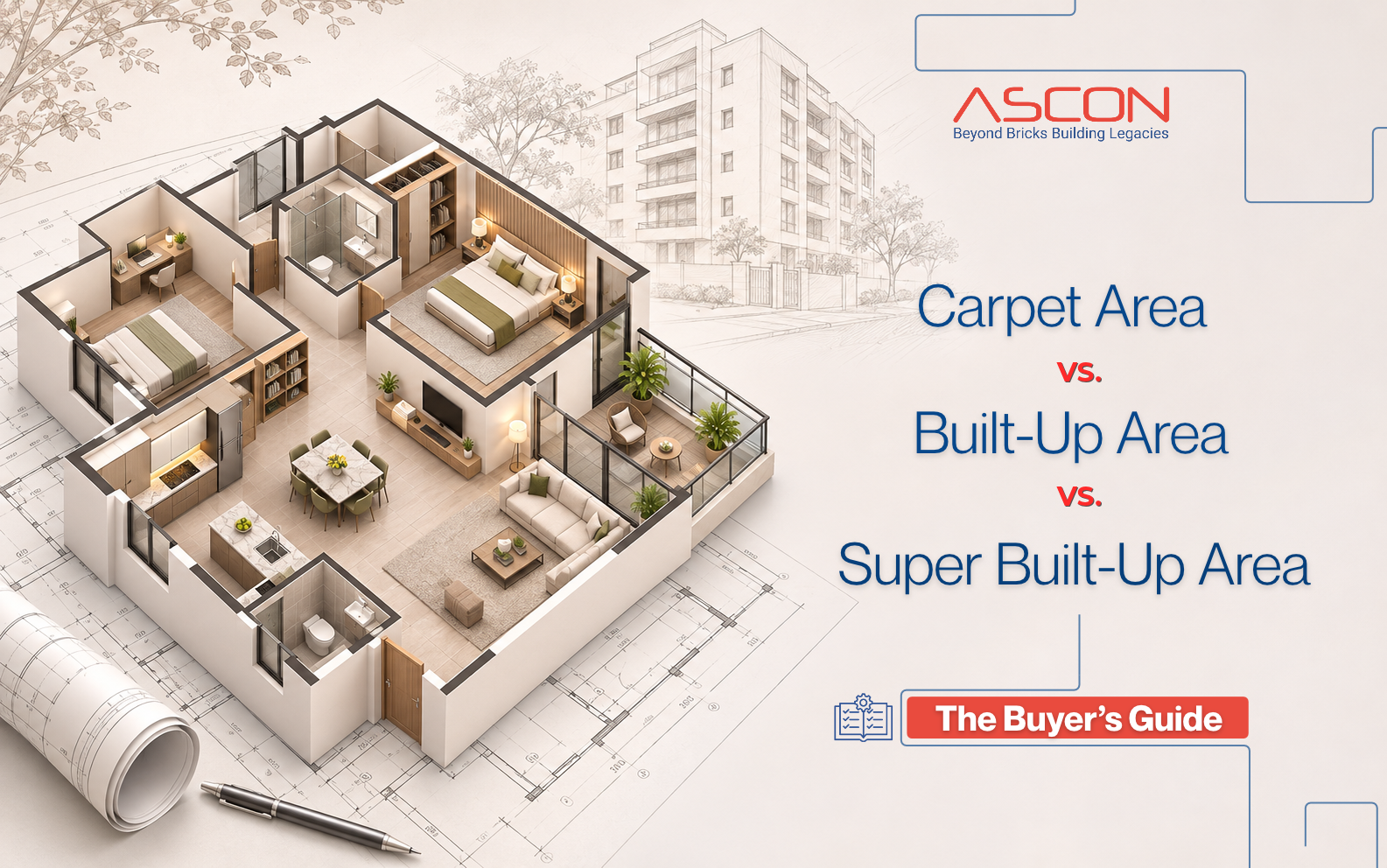
Carpet Area vs Built-Up Area vs Super Built-Up Area: What You Actually Pay For

2 November 2026

Carpet Area vs Built-Up Area vs Super Built-Up Area: What You Actually Pay For

Carpet Area vs Built-Up Area vs Super Built-Up Area: What You Actually Pay For

When you look at a flat, its size can be given in three different ways: carpet area, built-up area, and super built-up area. They are not the same number. In India's top seven cities, the super built-up area was on average 40% bigger than the carpet area in early 2025, according to ANAROCK. This guide shows what each one means and which one you should compare before you buy.

What Is a Carpet Area?

The carpet area is the floor space inside your flat that you can actually live in: the bedrooms, living room, kitchen, bathrooms, and passages. It's the most accurate measure of a flat's size and the only one defined by RERA. The RERA Act (Section 2(k)) calls it the "net usable floor area" of an apartment. What counts:
  • Every usable net floor space inside the rooms of the flat (living room, bedrooms, kitchen, bathrooms, and passages).
What does not count:
  • The thickness of both internal partition walls and external walls.
  • Service shafts for pipes and ducts.
  • Your exclusive balcony or verandah.
  • Your exclusive open terrace.
Balconies are kept out: under RERA, the balcony is separate from the carpet area. This was not always the case: Maharashtra's older flat-ownership law counted balconies as part of the carpet area, so figures from pre-RERA paperwork may not match today's.

What Is a Built-Up Area?

The built-up area is the full patch of floor that your flat takes up. It starts with the carpet area and then adds the things the carpet area leaves out: the thickness of the walls, inside and outside, and the balcony or terrace that belongs only to your flat. Some builders also add service shafts. In short: built-up area = carpet area + walls + your balcony (and sometimes shafts). A good way to picture it: if someone drew a line around your flat on the floor plan and measured everything inside that line, that would be the built-up area. One honest warning. RERA does not use built-up area as the basis for selling a flat, and its exact meaning changes from one builder and one city to another.

What Is a Super Built-Up Area?

A super built-up area is a built-up area plus your share of everything the whole building shares. You will also hear it called the saleable area or simply the super area. The shared spaces usually include:
  • Lobbies, corridors, and staircases
  • Lifts and lift lobbies
  • Amenities such as the clubhouse, gym, pool, and garden
Every flat in the building is given a proportionate slice of these spaces, and that slice is added to the flat's built-up area. In short: super built-up area = built-up area + your share of the common areas. That is why it is the biggest of the three numbers.  Where does it stand legally? The RERA Act defines only carpet area. It does not define a super area at all. In January 2024, UP RERA told builders to sell flats on carpet area only, and its chairman pointed out that the Act has no meaning for super area. But the super built-up area is still mentioned in brochures.

Loading Factor Explained:

The loading factor is the bridge between the carpet area and the super built-up area.    Turn it around and you can work out the super built-up area from the carpet area:   A quick example. A flat has a carpet area of 700 sq. ft. and a super built-up area of 910 sq. ft. The gap is 210 sq. ft., and 210 ÷ 700 = 0.30, so the loading is 30%. What share of your money buys usable space? Divide carpet by super built-up. For the flat above that is 700 ÷ 910, about 77%. Some people call this the efficiency of the flat. The higher it is, the more of the area you pay for is the area you can use. Remember what loading contains. The gap is not only common-area space. It also includes the thickness of your walls and your balcony, because those sit between carpet and super built-up too.

Carpet Area vs. Built-Up Area vs. Super Built-Up Area:

The three areas are nested, one inside the next. The carpet area is the smallest, the built-up area wraps around it, and the super built-up area wraps around both. One flat, three numbers.  
Carpet area Built-up area Super built-up area
In one line Usable floor space inside the flat Carpet area plus walls and balcony Built-up area plus your share of common areas
Includes internal walls Yes Yes Yes
Includes external walls No Yes Yes
Includes your balcony No Yes Yes
Includes lobbies, lifts, clubhouse No No Yes (your share)
Defined in RERA Yes, Section 2(k) Not a RERA sale basis No
Best used for Judging real space and comparing prices Reading floor plans Seeing how a builder arrived at the saleable area
Take a 2BHK flat with these figures from the builder's plan:  
Step Area (sq. ft.) What was added
Carpet area 640 Usable rooms and internal partition walls
Built-up area 740 + 52 for external walls and shafts, + 48 for the balcony
Super built-up area 864 + 124 as the flat's share of lobby, lift, stairs and clubhouse
  • Carpet Area: 640 sq. ft.
  • Built-Up Area: 720 sq. ft. (Carpet + internal/external walls + balcony)
  • Super Built-Up Area: 864 sq. ft. (Built-up + share of common amenities)
The loading here is (864 − 640) ÷ 640 = 35%.  In other words, a buyer paying for 864 sq. ft. gets 640 sq. ft. of floor to live on. The order never changes: carpet area is always smaller than built-up area, and built-up area is always smaller than super built-up area.

How to Verify the Area Before You Sign: 

Five checks protect you before you sign. Any builder worth buying from will welcome every one of them.
  • Check the agreement for sale: The carpet area in the agreement must match the carpet area declared for your flat. The price must be worked out on that carpet area, and the balcony must be listed as a separate item.
  • Ask for a full breakdown: A builder should give you the carpet area, balcony area, built-up area, super built-up area and loading for your flat, in writing. 
  • Check the floor plan: Multiply the length and width of each room and add them up. Wall thickness will cause a small gap. 
  • Read the area-variation clause: The carpet area can shift slightly during construction. Under RERA guidelines, this variation is typically capped at a maximum of 3%. If the final layout turns out smaller, the builder must refund the excess money within 45 days with interest. If it turns out marginally larger (within the legal limit), the developer may request a proportionate extra payment at the final milestone, calculated using the exact per-square-foot rate fixed in your original agreement. 
  • If you are taking a home loan, listen to the bank's valuer: The bank sends a technical expert to assess the property. If the carpet area the valuer finds differs from what the builder stated, take it up with the builder and settle the difference, including the price, before you proceed.

FAQ:

  • Which is more important, carpet area or super built-up area? Carpet area. It is the space you actually use and the only one of the three that RERA defines. Use a super built-up area only to understand how the builder reached the saleable figure.
  • How do I convert carpet area to super built-up area? Multiply the carpet area by (1 + loading ÷ 100). A 700 sq ft carpet area with 30% loading gives 910 sq ft. There is no fixed ratio, so you need the builder's loading for your project.
  • How is super built-up area calculated? It is the built-up area plus your share of the common areas. It can also be worked out as carpet area × (1 + loading ÷ 100).
  • Is stamp duty charged on carpet area or super built-up area? Stamp duty is paid on the higher of your actual transaction agreement value or the government's official circle rate (ready reckoner rate). Crucially, different state governments use different area metrics to calculate their baseline circle rates.
  • Is the balcony included in carpet area? Not under RERA. An exclusive balcony, verandah or open terrace is left out of the carpet area, so it should be listed separately in your agreement.

Search

Categories

Recent Posts

ASCON Infrastructure (India) Ltd announces their ASCON Irika and ASCON Era

23 March 2020

Natural Textiles Under The Brand name ASCON

11 November 2020

Magnificent Bar cum Restaurant located at Shop no. C-302, City Centre 1, Salt Lake City

13 April 2021

ASCON has regular export of Granite to the Middle East and Europe

26 November 2021

Progressive Web Applications with ASCON Softech

26 July 2022

ASCON presented Khola Hawa movie

13 April 2023

The 4 Stages of the Real Estate Cycle: What Every Homebuyer and Investor Should Know:

31 July 2026

Kolkata Real Estate in 2026: Is It Worth the Investment?

6 August 2026

Sale Agreement vs. Sale Deed: What Every Home Buyer Should Actually Know

13 August 2026

Break Free from EMIs: Smart Strategies to Make Your Home Loan Journey Debt-Free

17 August 2026

Stamp Duty and Registration Charges in West Bengal (2026): Essential Guide for Property Buyers

21 August 2026

Rajarhat vs New Town vs EM Bypass: Which Kolkata Corridor Should You Actually Buy Into in 2026?

22 August 2026

Builder-Buyer Agreement Explained: Everything a Homebuyer Should Know

2 September 2026

Under Construction vs Ready to Move Property: Which One Is Right for You?

11 September 2026

Home Loan for First Time Buyers: Complete 2026 Guide

19 September 2026

Property Tax in West Bengal: Essential 2026 Guide

25 September 2026

How to Check Property Value in West Bengal: Circle Rate vs Market Value Explained

14 October 2026

Carpet Area vs Built-Up Area vs Super Built-Up Area: What You Actually Pay For

2 November 2026

Announcements, Launch Info, and Special Deals!

Stay Informed About Our Latest Updates

Add your photo above. We’re always looking for the best talent.

From Ideas to Creation

Our Portfolio