Blog

2 September 2026

Builder-Buyer Agreement Explained: Everything a Homebuyer Should Know

Between the day you book your flat and the day you get possession, a lot can happen - and not all of it goes as planned. Today, we will discuss one document that plays a significant role in the entire journey: the Builder-Buyer Agreement. Most buyers, especially first-timers, find themselves confused when it comes to documentation. This document protects your money, timeline, and rights if things do not go as promised. Let us break down exactly what it is, why it matters, and everything you need to know about this document.

What is a builder-buyer agreement?

A builder-buyer agreement (BBA) is a legal contract between a real estate developer and a property buyer, typically signed for under-construction or pre-construction properties. This comes into play immediately after you have paid your initial booking amount, but before the property changes hands. Think of it as the rulebook for everything that happens between "I've booked my flat" and "I've got the possession." It talks about what the developer is promising to deliver and what you, as the buyer, are agreeing to pay and abide by.

Why is a Builder-Buyer Agreement Important for Homebuyers?

Many buyers treat this as routine paperwork. But it isn't. Here's why it deserves your full attention:
  • Legal protection: If the developer delays possession, alters specifications, or adds unfair charges, this agreement becomes your primary evidence in any dispute, whether that is a RERA complaint or a consumer court case.
  • Financial clarity: It plans out your entire payment schedule upfront, so you are never blindsided by an unexpected demand mid-construction.
  • Set expectations: From possession dates to promised amenities, the builder-buyer agreement holds all the commitments.

Key components of a builder-buyer agreement:

A solid Builder-Buyer Agreement should clearly spell out the following:

  • Property details : Unit number, Floor, Carpet area, Built-up area, and Super built-up Area
  • Payment schedule : Total cost and a construction-linked or time-linked payment plan.
  • Possession timeline : Promised handover date, with grace period and delay-penalty clauses
  • Specifications : Materials, fittings, and amenities promised
  • Title and legal clearances : Confirmation of clear land title and RERA registration
  • Cancellation and refund terms : Exit conditions for either party
  • Maintenance and handover terms: Who manages common areas until a housing society is formed.

Builder-Buyer Agreement vs. Agreement for Sale: What is the Difference?

This is where most buyers get tangled up, understandably, because the two terms are often used interchangeably today. Agreement for Sale: This is the precise legal term recognized under (Real Estate Regulation Act, 2016), which prescribes a standardized format that developers must follow, complete with mandatory disclosures. Builder-Buyer Agreement: on the other hand, started out as more of an industry term–the contract builders used before RERA existed, often without any fixed format. Today, in practice, the two have largely merged: what most people call a "BBA" is, in most states, the same RERA-mandated Agreement for Sale. (If you'd like a deeper breakdown of this distinction, we've covered it in detail in our earlier post:  [Agreement for Sale vs Deed of Sale -https://asconindia.com/sale-agreement-vs-sale-deed/]

How RERA Changed the Builder-Buyer Agreement

Before 2016, Builder-Buyer Agreements were one-sided. There was no fixed format, which meant buyers often signed contracts with one-sided clauses.  RERA also ensured that most states follow a fixed, standard format for the BBA. Thus, no matter which builder you sign with, the agreement must clearly state the project's registration details, exact carpet area, and delay compensation, giving buyers a much fairer deal than they used to get before.

Frequently Asked Questions:

Is a builder-buyer agreement legally binding? Yes. Once signed and registered, it is enforceable under the Indian Contract Act and RERA. Courts recognize it as long as the terms are fair and RERA-compliant.

What happens if I want to cancel after signing? RERA limits how much a builder can forfeit if you cancel, typically 10–20% of what you have paid, depending on the state and stage of the transaction. If the delay or default is on the developer’s side, you are usually entitled to a full refund with interest.

Conclusion:

A Builder-Buyer Agreement - or, as it's formally known, the Agreement for Sale - isn't just paperwork standing between you and your new home. It is the document that decides how protected you are if anything goes wrong along the way. As a developer, we believe that transparency should not be something buyers have to fight for; it should be the starting point. We guide you through every step of your home-buying journey, from your first query to the day you receive your keys. Follow us to begin your home-buying journey. ASCON Infrastructure (India) Ltd. Learn more: https://asconindia.com/
22 August 2026

Rajarhat vs New Town vs EM Bypass: Which Kolkata Corridor Should You Actually Buy Into in 2026?

Kolkata is expanding fast, and so is the list of growth corridors investors keep circling back to. As the city's population rises and people's needs, budgets, and priorities keep shifting, one question comes up again and again whether you're buying your first home or adding to an investment portfolio: which of these corridors is actually worth your money? Honestly, it's not the right question. A 32-year-old IT professional buying his first flat and a 55-year-old businessman upgrading to a forever home aren't shopping for the same thing, even if they're both looking at a 3 BHK in East Kolkata. So rather than ranking these corridors, we'll give you an honest look at what each one offers, what the 2026 numbers actually say, and where each could go wrong for the wrong buyer.

Let's unfold a Common Confusion : New Town and Rajarhat Are Not the Same Place

This trips up almost every first-time buyer. People say "Rajarhat" when they mean New Town, and vice versa. Here's the actual geography: Rajarhat is the larger administrative belt in North 24 Parganas. New Town - sometimes called Rajarhat - is New Town. It is the HIDCO-planned smart city carved out inside that belt, with its own development authority (NKDA), grid roads, and a clear master plan going back to 1999. In practice, this means New Town proper (Action Area I, II, and III) is more expensive, better planned, and closer to being a finished neighborhood. The broader Rajarhat belt around it, like Jyangra, Hatiara, and Chandpur, is cheaper, less developed, and a longer-term bet. When people compare "Rajarhat" against EM Bypass, they're usually talking about New Town's Action Area I and II. This is worth the evaluation.

The Numbers, Side by Side - What You'll Actually Pay in 2026:

These are the current listing data, and this is cross-checked against recent market reports before writing this. There's some spread depending on the exact project and micro-pocket, but here's a fair, honest range for 2026:
What You're Comparing New Town / Rajarhat EM Bypass
Average price per sq ft ₹5,000 – ₹9,500 ₹8,300 – ₹12,000+
Entry-level 3 BHK ticket size ₹60 lakh – ₹1.5 crore ₹1.5 crore – ₹3.5 crore
Rental yield 4% – 7% 3% – 5%, with select luxury projects touching 5–7%
1-year appreciation ~10%, up to 20%+ in Action Area II ~8–9%, top projects touching 9.5%
5-year appreciation Roughly 40–66% for early entrants Roughly 50–55%
Resale liquidity Growing, strongest in AA-I & AA-II Deepest luxury resale market in the city
  A note on rental yield: figures vary across sources. In reality, both corridors have pockets that outperform the average, and yield depends on the specific project and unit type. What stays consistent is the driver behind each: New Town's yield comes from steady IT-tenant demand, while EM Bypass's comes from a smaller but higher-paying luxury rental segment. Either way, yield alone shouldn't decide your purchase.

New Town & Rajarhat: The Planned City Still Writing Its Own Story

New Town isn't an organic neighborhood that grew over time; it was engineered from scratch, and that's exactly what makes it stand out. HIDCO planned it with wide six-lane roads, underground utilities, and even India's first Wi-Fi-enabled road along Biswa Bangla Sarani. Eco Park gives it a proper green anchor. On the regulatory side, NKDA has been notably more consistent with approvals compared to the older, KMDA-governed parts of the city. The demand here comes from one clear source: jobs. Sector V sits right at New Town's edge, and Bengal Silicon Valley - the state's biggest tech park initiative is coming up inside New Town itself. That means a steady stream of young IT professionals who want to live close to work. This is exactly why rental demand here hasn't slowed down. The one number every buyer should know right now is the Orange Line Metro. It's a 29-km stretch connecting New Garia to the airport, running through Ruby, EM Bypass, New Town, and Sector V. Full commissioning is targeted for December 2026, with just one real hurdle left - a 366-metre viaduct gap at Chingrighata. Once it's done, the New Garia-to-airport commute drops to around 56 minutes. Buyers who entered between 2020 and 2022 have already seen gains of over 40%. Where the growth is still catching up: Step outside Action Area I and II, and the story shifts from "established" to "emerging." Action Area III and the outer Rajarhat pockets - Hatiara, Jyangra - are priced lower simply because their social infrastructure is still catching up, which is exactly why long-term investors keep an eye on them.

EM Bypass: Kolkata's Address That Doesn't Need an Introduction

EM Bypass isn't trying to become a neighborhood - it already is one, and has been for over a decade. This is where Kolkata's established money lives. ITC Royal Bengal, JW Marriott, ITC Sonar, Acropolis, South city, Fortis, Peerless, Medica - this stretch has the deepest social infrastructure of any residential corridor in the city, built up over 30+ years since the Bypass itself was completed back in 1982. That maturity shows up directly in price. You're looking at a meaningfully higher entry ticket than New Town - often 40–60% higher on a per-square-foot basis - but you're also buying into the corridor with, by far, the deepest luxury resale market in Kolkata. Over 90% of the city's luxury segment demand is said to concentrate across EM Bypass, Ballygunge, and Salt Lake combined. If you ever need to exit a ₹2–3 crore property quickly, this is where you'll find a buyer fastest. Connectivity-wise, EM Bypass already has a working stretch of the Orange Line - operational from Kavi Subhash through Ruby - while New Town is still waiting for its segment. So this isn't a "future promise" corridor; the metro benefit here is partially real today.

What the September 2025 Circle Rate Revision Actually Means for You:

Here's a number most buyers overlook - but it affects everyone buying in either corridor. In September 2025, the West Bengal government revised circle rates across the state, with increases ranging from 15% to as high as 90% in some areas. It's the biggest revision in nearly a decade. What does this mean for you? Simply put, your stamp duty is now higher than it would have been a year ago. The effect plays out a bit differently in each corridor. On EM Bypass, circle rates were already close to real market prices, so the impact shows up more directly in rupee terms. In New Town and Rajarhat, the old rates were more conservative, so the percentage increase looks bigger - but the actual rupee impact per unit is usually smaller. What are rupee terms? "Rupee terms" simply means looking at the actual amount of money in rupees, rather than looking at a percentage. For example: a 10% increase on ₹10,000 is ₹1,000. A 50% increase on ₹1,000 is ₹500. The second one has a bigger percentage, but the rupee-term impact is smaller. Either way, don't ignore this while budgeting. A lot of buyers only calculate the flat's base price and forget stamp duty, registration charges, and this revised circle rate. That's the most common reason people are caught off guard at the registrar's office - short by a few lakhs they didn't plan for.

Who Should Actually Buy Where - Our Honest Take:

  • You're an IT professional buying your first home, with a budget under ₹1 crore. New Town or Rajarhat's Action Area I/II, without much debate. You get proximity to Sector V, a strong and recurring tenant base if you ever rent it out, and genuine growth ahead of the Orange Line opening. If you're specifically looking in this bracket, it's worth knowing the Penchar More stretch in New Town has been drawing a lot of first-time buyer interest lately and our own project, Ascon Arvia, sits right there, which is partly why we keep tracking this pocket so closely.
  • You're upgrading to a forever family home, budget ₹1.5 crore plus, and want everything ready today.
  • EM Bypass. You're not waiting for schools, hospitals, and malls to be built around you, as they already are.
  • You're an NRI planning 5-7 years: Go with New Town, especially Action Area II. The metro upside is still ahead of you, and entry prices are lower. If quick liquidity matters more to you, EM Bypass is the safer choice.
  • Your main goal is rental income, not just appreciation: Both corridors can work here. Just check the specific project's tenant base before buying. New Town has a steadier IT-tenant pool, while EM Bypass units usually earn higher rent in absolute terms, even if the yield percentage looks about the same or lower.
  • Your budget is under ₹60 lakh: EM Bypass isn't really an option at this price in new launches today. Start your search in Rajarhat's outer pockets instead.

Our POV, as a Developer:

If you ask us where the next five years of genuine value creation is happening in East Kolkata, we'd point you toward New Town and Rajarhat's Action Area I and II — not because EM Bypass is a bad buy, it isn't, but because the biggest driver of price movement in real estate is always the gap between what a place is today and what it's about to become. EM Bypass has already become what it's going to be. It's a mature, excellent, expensive address, and it will hold its value exceptionally well. New Town hasn't finished becoming what it's going to be. There is more development potential in this area. Action Area III hasn't caught up to Action Area I yet. That gap between today and tomorrow is where the real return sits - and it's exactly why we've chosen to build here. Our residential and commercial developments are thoughtfully planned and spread across the city, so you can choose what suits you and your convenience best. We're here to guide you through every step of that decision - because whether you're investing, buying your first home, or growing your business, we know how important this choice really is to you. Connect with our team today. ASCON Infrastructure (India) Ltd. Learn more: https://asconindia.com/
21 August 2026

Stamp Duty and Registration Charges in West Bengal (2026): Essential Guide for Property Buyers

There's a particular moment every property buyer goes through. You've selected the flat, negotiated the price, maybe even started measuring windows for curtains - and then, especially for first-time homebuyers, one term brings everything to a pause: stamp duty and registration charges. Stamp duty rarely gets talked about the way property prices do, so most buyers only understand it once they deeply check the paperwork, which is a bit backwards and can add 6-8% to your total cost. This guide covers what are stamp duty and registration charges in West Bengal right now, and how the registration process actually works. Let’s get into this.  

What Is Stamp Duty?

Stamp duty is a tax the West Bengal government charges when property ownership changes hands. It's governed by the Indian Stamp Act, 1899, though each state sets its own rates - which is why the same 2BHK could attract different stamp duty in Kolkata versus, say, Pune or Chennai. Here's the part that surprises people: signing a sale agreement and paying the seller doesn't actually make you the legal owner until stamp duty is paid and the sale deed is registered with the government. What you have is essentially a private contract between two parties, not something that would hold up cleanly if a dispute ever landed in court, or if you tried to sell the flat five years down the line. Paying stamp duty and getting your deed registered is what closes that gap. It's the step that makes your name show up in official government records as the owner.  

Stamp Duty and Registration Charges Aren't the Same Charge:

People often get confused between these two together, but they're separate line items with separate purposes. Stamp Duty is the tax on the transaction - a percentage of the property's value. Registration Charge is what you pay to have your sale deed physically entered into government records at the Sub-Registrar's office. This is the part that actually protects you against fraud, forged sale deeds, or someone else quietly claiming rights over the same property later.  

Stamp Duty and Registration Charges in West Bengal, 2026:

This is the number most people are here for, so let's get straight to this. West Bengal splits rates by location - Kolkata Municipal Corporation (KMC) and other municipal or corporation areas on one side, rural Panchayat areas on the other. 
Kolkata (KMC) and other municipal/corporation areas
Property Value Stamp Duty Registration Charge
Up to ₹1 crore 6% 1%
Above ₹1 crore 7% 1%
 
Rural (Panchayat) areas
Property Value Stamp Duty Registration Charge
Up to ₹1 crore 5% 1%
Above ₹1 crore 6% 1%
So a buyer in Kolkata is generally looking at 7% of the property value in total government charges for anything up to ₹1 crore, and 8% beyond that. Rural buyers pay a percentage point less across both slabs.  West Bengal did offer a temporary 2% stamp duty rebate along with a 10% reduction in circle rates during the pandemic years, to keep the property market moving. That relief ended on 1st July 2024.  It's also worth knowing that West Bengal doesn't currently offer a lower stamp duty rate for women buyers, unlike states such as Delhi or Haryana. The one real exception to the standard slab is a gift deed within the immediate family - spouse, children, parents, or siblings - which attracts a concessional 0.5% rate instead of the full 6-7%. Also Read: Agreement for Sale vs. Deed of Sale: What Every Home Buyer Should Actually Know

How Stamp Duty Is Actually Calculated:

It's calculated on whichever is higher - your agreement value, or the government's circle rate for that property. Circle rate, if you haven't come across the term, is the minimum value the government assigns to a property based on its location, type, and the infrastructure around it.  So even if you've bargained and are paying less than that, you still can't pay stamp duty on your lower price - the circle rate is what actually counts.  A quick example. Say you're buying a flat in Kolkata for ₹65 lakh, and that figure is at or above the applicable circle rate.
  • Property value: ₹65,00,000
  • Stamp duty at 6%: ₹3,90,000
  • Registration charge at 1%: ₹65,000
  • Total payable to the government: ₹4,55,000
That's close to 4.5 lakh on top of the purchase price - not a small number, and exactly why it deserves your knowledge from the very beginning.  

Factors Impacting the Stamp Duty Rate:

Where the flat is: KMC, other municipal zones, and rural Panchayat areas each answer to a different rate table.

How much it's worth: Crossing the 1 crore mark can straight increase the percentage on point in duty. 

What kind of deed you're registering : A standard sale sits at the regular rate. Gifting property to close family is discounted. Leases and mortgages are governed by entirely separate rules that don't map onto sale transactions at all.

Carpet area versus super built-up area: From January 2024 onward, registration in the state has been based on carpet area rather than the larger super built-up figure. In theory, that means you're no longer paying duty on shared spaces like staircases and lobbies.


Paying Stamp Duty in West Bengal - How It Actually Works

The good news is that West Bengal's system is almost entirely online now, run through GRIPS - the Government Receipt Portal System - linked from the Directorate of Registration and Stamp Revenue's official site, wbregistration.gov.in. The flow generally looks like this: You start by working out your numbers using the calculator sitting under the portal's 'E-Services' section - it'll spit out the applicable market value, stamp duty, and registration fee for your specific case. That generates an e-Assessment Slip, carrying a Query Number and Query Year. Keep them carefully; you'll be typing them in again shortly. Next, you move to the e-Payment section of the same portal and feed in that Query Number and Year, which bounces you over to GRIPS itself - the actual gateway. Inside GRIPS, you'll pick 'Payment of Taxes & Non-Tax Revenue' and select the Directorate of Registration and Stamp Revenue from the department list. From there, paying is straightforward - you can use net banking, UPI, debit card, or SBI e-Pay to pay the amount. Once it clears, download and keep the e-Challan somewhere safe. It carries a GRN and a BRN - a Government Reference Number and a Bank Reference Number and you'll be asked to produce both on the day you go in for registration. Worth knowing upfront: this state doesn't really accept cash or demand drafts for stamp duty anymore. It's GRIPS or nothing, so it's worth logging in and getting familiar with the portal well before your registration date.  

The Documents You Need: 

These are the documents that you need to bring with you to the Sub Register’s office.
  • The sale deed
  • Identity proof for both buyer and seller - Aadhaar, PAN, Voter ID, or Passport
  • PAN cards for both parties, mandatory once the deal crosses ₹10 lakh
  • Passport photographs
  • Property tax receipts
  • Khatian or mutation papers, where relevant
  • An encumbrance certificate, if one applies to your case
  • Address proof
  • Your stamp duty e-Challan
 

Conclusion: 

Understanding stamp duty and registration charges beforehand can help you plan the true cost of your property purchase more confidently. This is actually doing a very important task for you : it is what converts a private agreement between two parties into something a bank, a court, and the state will recognize without dispute. It is what allows you to pledge the property against a loan in future. It is what keeps a resale free of legal complications and it's what lets your children inherit the property without having to prove a thing to anyone.  At Ascon, we believe a decision of this scale deserves more than a transaction- it deserves clarity. Buying a home is, for most families, the single biggest financial decision they will ever make, and we don't think our job only ends at handing over the keys. It includes making sure the people who place their trust in us understand exactly what they are signing up for- the costs, the process, and the fine print that no one bothers to explain. This guide is part of that commitment, and one we intend to keep updating as regulations evolve. Figures and procedures referenced in this guide reflect West Bengal's position as of 2026, drawn from the Directorate of Registration and Stamp Revenue's published notifications. As government rates and rules are periodically revised, we recommend a final verification on wbregistration.gov.in, or a consultation with a qualified professional, before finalising your budget. Connect with our team today. ASCON Infrastructure (India) Ltd. Learn more: https://asconindia.com/  
17 August 2026

Break Free from EMIs: Smart Strategies to Make Your Home Loan Journey Debt-Free

Every year on August 15th, we celebrate the Independence of our country. Flags go up, songs play, and there is a collective feeling of pride in the air . While Independence Day is about celebrating our nation's freedom, it can also be a moment to think about our own financial freedom - including the smart choices that can help us pay off home loan faster and move closer to a debt-free future. This year, while we celebrate our Independence, we wanted to pause and reflect on something closer to home. As a real estate developer, we've had the privilege of handing over keys to hundreds of families - and for so many of them, it's their first home, bought with their first home loan. There's so much trust that goes into that decision. Along with the excitement of owning a home, there's also this quiet, long-term commitment that comes with it - the EMI. Therefore, on this Independence Day, we wanted to talk about something a little different. Not just about owning a home, but about making that journey a little smoother. If you're looking to pay off  home loan faster, a few smart financial decisions can help ease your EMI journey, reduce the interest you pay over time, and even shorten your loan tenure. Let’s get into this.

Want to Pay Off Your Home Loan Faster? First, Understand What You're Actually Paying For:

Before we discuss strategies to pay off  home loan faster, here is something many homeowners do not realize: in the first several years of your home loan, a large portion of your EMI goes toward interest, rather than reducing the actual loan amount (principal). This balance gradually starts shifting in your favor during the later years of the loan.

This is exactly why prepaying even a small amount early in your loan tenure can have such a significant impact. By reducing the outstanding principal earlier, you can potentially save on interest and move closer to your goal of becoming debt-free sooner.

1: The "13th EMI" Trick

This is one of the most effective things you can do, and most people have never even heard of it. Instead of paying the usual 12 EMIs per year, one pays one extra EMI. One additional payment is directly applied to the principal. Sounds too simple to make a difference? It's not. Because that extra payment hits your principal early, you save interest on it for every remaining month of your loan, and because this compounds year after year, the savings add up fast.

How to actually pull this off:

  • Save a little each month - You can save roughly 8-9% of your EMI amount separately every month and pay it as a lump sum once a year.
  • Use your bonus or increment: Diwali bonus, annual bonus, tax refund - money that was not part of your regular budget anyway, so you will not even feel the pressure to save it.
  • Round up your EMIs: Some people pay slightly more than required each month, and by year-end, it adds up to roughly one extra EMI.

A rough example to understand this in a simple way is as follows:

Suppose you have taken a loan of ₹50 lakh at 8.5% interest for 20 years. Your EMI is approximately ₹43,391 a month.
  • This means that your total repayment–principal plus interest–comes to approximately ₹1.04 crore, on a loan amount of ₹50 lakh.
  • However, if you pay one extra EMI every year toward your principal, your tenure could shrink to around 14–15 years instead of 20. That's up to 6 years shaved off–and somewhere around ₹ 16–18 lakh saved in interest.
(These numbers will vary depending on your bank, interest rate, and when exactly you make the payment ) Two things you absolutely need to get right:
  1. Talk to your bank about "principal prepayment," not an advance EMI: If you just pay next month's EMI early, it does not reduce your principal the same way. You need to specifically request a part-prepayment.
  2. Choose "reduce tenure," not "reduce EMI." When you prepay, most banks give you a choice: either your EMI amount goes down (tenure stays the same), or your tenure shrinks (EMI stays the same). If your goal is to pay off home loan faster and save the most interest, always choose tenure reduction.
One more useful thing to know is that if you are on a floating interest rate (which most home loans are), the RBI has made it mandatory that banks cannot charge you any prepayment penalty. Therefore, this strategy genuinely costs you nothing extra. Fixed-rate loans may still have some charges; therefore, you should always double-check your loan agreement.

2: Let Your EMI Grow With Your Salary

Every time you get a hike, you have a choice to make: spend a little more on yourself from that increased amount or put that extra bit toward your loan.

Here is an easy way to do it: increase your EMI in line with your salary every year. Since your income is growing, you probably will not feel a significant difference in your monthly budget.

If your goal is to pay off home loan faster, gradually increasing your EMI as your income grows can be a practical way to get there without putting too much pressure on your current lifestyle.

That small yearly increase? Over time, it can add up to a much shorter loan tenure and a lot less interest paid overall.


3: Consider Refinancing if it benefits you:

If you took out a loan a few years ago and interest rates have dropped than before, or if another lender is offering a noticeably better rate, it might be beneficial for you to look for a balance transfer. First, do your math, which should include factors like processing fees and other transfer costs, and make sure that the long-term interest savings outweigh the short-term cost of switching.

4: Don't Let Lifestyle Inflation Eat Your Freedom

This is more of a mindset shift than a strategy. It is easy to let bonuses and hikes quietly disappear into upgraded lifestyles–a fancier car, more frequent trips, the next big gadget. Honestly, that's natural and happens the most. But if you are a little more patient about it, that same money can do something much bigger for you. Before you spend it, ask yourself: what if a portion of that went toward paying off your home loan faster instead? Using a part of your bonuses or salary hikes this way can help you pay off home loan faster and reduce your long-term financial burden. Think of it as paying your future self, the one who gets to be debt-free years earlier.

A Couple of Things to Watch Out For:

  • Do not drain your emergency fund to prepay. Keep your 3-6 month safety net untouched. EMI freedom should not cost you financial security.
  • Check your tax benefits first. Home loans offer deductions under Sections 80C and 24(b); therefore, understand your current savings before prepaying aggressively.

Conclusion:

Freedom comes in many forms. Sometimes it is the country breaking free from rule, and sometimes it is an individual breaking free from something quieter, such as a loan, a limitation, or a long-term commitment that has been sitting on their shoulders. But at the core, we are all chasing the same feeling– the happiness that comes with being independent and not being stuck anymore. Every extra payment you make, every smart choice you take today, can help you pay off home loan faster and take a step toward that same feeling - owning your home truly, completely, on paper and in spirit. As a real estate developer with over 30 years of legacy, our people have always come first to us. That does not end with handing over the keys; we want to walk this journey with them. Wishing you all a very Happy Independence Day. ASCON Infrastructure (India) Ltd. Learn more: https://asconindia.com/
13 August 2026

Sale Agreement vs. Sale Deed: What Every Home Buyer Should Actually Know

Sale Agreement vs. Sale Deed: What Every Home Buyer Should Actually Know

Buying a home is exciting, but somewhere between the excitement and the paperwork, most buyers hit a moment of confusion. You sign one document, and it feels like the home is already yours. Then, weeks or months later, you are asked to sign another one. So, which one actually makes you the owner? Every document that you sign during your home buying period.. all of them have their own purpose and value. Understanding the sale agreement vs sale deed difference can save home buyers from a lot of confusion during the property-buying journey. This is one of the most common and important questions we receive at ASCON and honestly, it's a fair question because the two documents sound similar, but they do not do the same job at all.  Let's break this down in simple terms.

What is an Sale Agreement? 

Think of an agreement for sale as a promise, written down and made legally binding. This document is where the developer and buyer agree on the terms of the sale: the price, payment schedule, possession date, and what exactly is being promised (the layout, the specifications, the amenities). Both sides put their commitment on paper. But here's the key part: signing this document doesn't make you the owner yet. Ownership has not been transferred. What you have is a legally protected promise of the property's delivery, once certain conditions, such as full payment, are met.

What Usually a Sale Agreement Contains: 

  • The payment plan - how much, and when, whether it's linked to construction stages or a fixed timeline
  • The possession date - including any grace period the developer is allowed
  • What you're actually getting - the layout, materials, and amenities promised
  • What happens if something goes wrong, and the penalties if either the buyer or the developer does not hold up their end.
It's essentially the roadmap for how the sale is going to happen.

What is a Sale Deed?

If the Agreement for Sale is the promise, the Deed of Sale is the moment when that promise is finally kept. This is the document that actually transfers ownership from the developer to you. It is registered with the local Sub-Registrar's office, which makes it legally official–this is what the law recognizes as proof that the property is now completely and absolutely yours. Once this is signed and registered, the developer has no further claims on the property. You can now call yourself the complete owner.

What You'll Usually Find in a Sale Deed?

  • A clear title declaration confirming that the property has no pending loans, disputes, or legal issues attached to it.
  • Proof of full payment - including stamp duty and registration charges
  • An indemnity clause is a developer's legal commitment to protect you if any hidden title issue surfaces later.
  • Full possession -the keys, utilities, and complete control of the property-handed over to you.

Sale Agreement vs Sale Deed: What Is the Actual Difference?

When understanding sale agreement vs sale deed, the simplest distinction is this: the Agreement for Sale sets out the terms and conditions of the transaction, while the Sale Deed completes the transfer of ownership . Together, these two documents protect you throughout the process, making the relationship between the buyer and developer formally secure and ensuring that the entire journey moves toward a smooth and transparent completion. It is not just beneficial for the buyer; it protects both parties involved. A quick way to remember this: If you are still waiting for possession or making payments, you are most likely still under an Agreement for Sale. Once the Deed of Sale is signed and registered, the property is legally and unquestionably yours.

Sale Agreement: Residential vs. Commercial

If you are buying a residential property, the Agreement for Sale mainly covers the things that matter most, such as when you will get possession, your home loan approval timeline with the bank, and the developer’s responsibility to fix any defects after you move in.

If you are buying a commercial space, the agreement usually covers a few extra things, such as maintenance costs shared between tenants (often called CAM charges), approvals needed for running a business at that location, and protections for any tenants already operating there.

Sale Deed: Residential vs. Commercial

For a residential property, the deed of sale is what finally makes the house, flat, or plot legally yours, including possession, your share in the land (if it is an apartment), and complete ownership once payment is completed. For a commercial property, the deed usually covers more, such as your rights to put up signage, parking spaces for your business, shared responsibility for maintaining the building structure, and following local rules for running a business.

Why This Matters:

Whether you are buying a home to live in or a space to grow your business, the core idea remains the same: one document sets the terms, and the other finalizes ownership. 

Our Take, as Your Developer

At ASCON, we believe that a home buyer should not need a law degree to feel confident about their purchase. Understanding sale agreement vs sale deed can help buyers approach the property-buying process with greater clarity and confidence. Every family that trusts us with their biggest decision deserves complete clarity, from the very first agreement to the final deed, and everything in between. This is not merely a legal formality for us. It is part of how a trusted relationship grows between us and the people who believe in us. If you are currently exploring any property, whether residential or commercial, our thoughtfully  developed projects are ready to grow with you.   Connect with our team today. ASCON Infrastructure (India) Ltd.   Learn more: https://asconindia.com/   * This blog is intended for general informational purposes only and does not constitute legal advice.   
6 August 2026

Kolkata Real Estate in 2026: Is It Worth the Investment?

Kolkata Real Estate in 2026: Is It Worth the Investment?

Purchasing a property is often considered one of the most secure ways to build long-term wealth. However, with fluctuating prices, new developments, and changing buyer preferences, a key question remains: Is investing in Kolkata real estate still a good idea in 2026? Kolkata has long been recognized for offering reasonably priced homes, strong cultural traditions, and consistent demand for residential properties. In recent years, new metro lines, the rise of business districts, and the expansion of residential areas have started to transform the city's real estate scene. That still comes down to the factors including the location, accessibility, the developer, the price, and the future demand of that area. This blog is our attempt to walk through what's actually happening in Kolkata's market right now, and what we think is genuinely worth paying attention to.

Kolkata Real Estate in 2026: Why Is This Question Becoming More Relevant?

For many years, Kolkata's real estate market quietly remained in the shadow of cities like Bengaluru, Hyderabad, Pune and Mumbai. While these markets experienced rapid appreciation and periods of intense investor activity, Kolkata earned a reputation for being a city of stable prices and steady demand. That perception is now shifting. The conversation around Kolkata is no longer centred only on affordability. Instead, it is increasingly focused on future potential. Over the past few years, the city has seen consistent improvements in infrastructure, expanding metro connectivity, the continued growth of planned townships like New Town and Rajarhat, and stronger commercial activity in emerging business districts. At the same time, the buyers themselves are changing. Ten years ago, buying a flat was mostly an emotional call - you needed a home, so you bought one. Now buyers spend weeks comparing developers, checking connectivity plans, reading up on RERA filings, and actually thinking about resale value before making a commitment. There's also a shift in the question investors are asking. It used to be "which city is growing fastest." Now it's "which city still has room left to grow." Investors are no longer looking only for markets that have already grown and saturated- they are looking for markets that still have the potential to grow sustainably over the next decade.

Kolkata Is Finally Showing Up in the Numbers :

Here's something that would have surprised most investors a few years back: in the first three months of 2026, home sales actually fell by around 4% across India's eight biggest cities. But Kolkata didn't follow that trend - it went up. Around 4,043 homes were sold in the city, a 5% jump compared to the same time last year. So while the bigger, more talked-about cities were slowing down, Kolkata kept moving. Prices moved too, just not dramatically. The average rate touched around ₹5,900 per square foot, about 3% higher than the year before. It's the kind of slow, steady climb that usually points to a healthier market than a sudden boom does. And it wasn't just buyers showing up. Developers kept building right alongside them, with thousands of new homes launched in the same quarter. So you're not looking at a shortage-driven price jump here. Demand and supply grew together, roughly at the same pace - which is generally what a market looks like when it's maturing. Understanding Kolkata Real Estate in 2026 requires looking beyond property prices and considering infrastructure, employment opportunities, connectivity, and future growth corridors. Kolkata Real Estate in 2026

The Key Factors Driving Kolkata's Real Estate Market :

1. Expanding Metro Connectivity :

Kolkata's metro network is gradually connecting more parts of the city, making daily travel faster and more convenient. Areas that were once considered distant are becoming more accessible, which is encouraging both residential and commercial development along these corridors.

2. Better Roads and Transport Infrastructure :

Improved road networks, flyovers and better connectivity between key locations have made commuting easier across the city. As accessibility improves, many emerging neighborhoods are becoming practical choices for both homebuyers and investors.

3. Emerging Growth Corridors Across Kolkata :

While New Town and Rajarhat continue to attract attention for their planned urban development, they are no longer the only locations shaping Kolkata's real estate market. The extension of metro connectivity and ongoing infrastructure improvements have also brought areas like Joka & Southern Bypass into the spotlight. These localities, once considered relatively distant from the city's commercial centers, are becoming increasingly accessible. As connectivity improves, they are witnessing growing residential interest, new housing developments and improved social infrastructure. Similarly, neighborhoods such as EM Bypass, Madhyamgram, BT Road and the Airport corridor continue to benefit from better road networks, expanding civic amenities and their proximity to important business and transport hubs. Each of these locations offers a different investment proposition.

4. Expanding IT and Commercial Hubs :

Business districts such as Sector V, New Town and nearby commercial zones continue to generate employment opportunities. As workplaces expand, the demand for quality housing, rental properties and supporting infrastructure naturally grows alongside them.

5. Continued Government Investment in Infrastructure :

Public investment in metro projects, roads, urban development and civic infrastructure is steadily improving the city's overall connectivity and livability. While infrastructure projects take time to deliver their full impact, they often play an important role in shaping future real estate demand. Alongside this, shifts in governance have also brought a renewed sense of optimism to the market, with many buyers and investors sensing a more stable and encouraging environment ahead.

6. Better Lifestyle and Social Infrastructure :

Today's homebuyers look beyond just four walls. Easy access to schools, hospitals, shopping centers, parks, entertainment hubs and everyday conveniences has become an important factor when choosing where to live.

Where the Money Is Actually Moving:

Not every part of Kolkata is growing at the same pace, and as developers, this is something we track closely before deciding on our next project. Areas like Phoolbagan and pockets of Action Area 1 have seen some of the sharpest price gains over the last three years. On the other hand, established neighborhoods like Ballygunge and Alipore continue to hold their value simply because they are established. New Town tells a slightly different story. Flat prices there have softened a little over the past year - but not because buyers have lost interest. It's simply because a large number of new projects, including ours, have entered the market at the same time. We see this as a natural pause, not a warning sign. It's the kind of short-term adjustment that usually happens right before the next phase of growth, especially as metro connectivity in the area catches up with how fast construction has moved. Meanwhile, we're seeing some of the strongest buyer interest in peripheral growth corridors - Joka, Rajarhat, and the stretch along the Southern Bypass. Buyers are drawn here for a simple reason: prices are still accessible, and connectivity keeps improving month on month. As a developer, this is exactly the kind of location where we believe early buyers stand to gain the most over the next few years. You can explore our ongoing real estate projects to learn more about the locations and developments currently offered by ASCON. If you are evaluating Kolkata Real Estate in 2026, these are the factors that deserve the closest attention before making an investment decision.

Things Every Buyer Should Check Before Investing:

We've sat across the table from enough buyers - first-timers and repeat investors alike - to know that the good decisions almost never happen in a rush. These are the important factors to look into before investing:
  • Builder reputation: Checking the developer's past portfolio is the clearest indicator of trust and credibility.
  • RERA approval: Check the project's RERA availability, eligibility depending on factors like plot size and unit count. A conversation with the developer is important to get clarity. For more information about real estate regulations in India, visit the official RERA website.
  • Connectivity: Don't just judge a locality by how it feels today. Checking the future prospects of a locality and what's planned for the next few years is usually the single biggest factor behind future price growth.
  • Construction quality: Look past the sample flat. Ask about the materials being used and, where possible, walk through a site that's under construction or recently completed.
  • Future infrastructure: A locality's value five years out depends heavily on what's coming - new metro lines, flyovers, IT parks, hospitals. Buying early into an area with solid infrastructure plans is usually a smart decision.
  • Resale potential: Even if you're buying to live in it, ask yourself: if I needed to sell this in five or ten years, would there be buyers? Locality reputation and developer track record both play into this.
  • Rental demand: If this is meant to be an investment, check what similar flats nearby are renting for and how quickly they get tenanted.
We talk about this because we'd rather you make an informed call than a rushed one. It's also the same standard we try to hold ourselves to that you can verify on-site rather than just take our word for. Kolkata Real Estate in 2026 presents opportunities for buyers who focus on long-term growth rather than short-term market fluctuations.

So, Is It Actually Worth It?

Kolkata isn't going to give you the kind of overnight appreciation you heard about in parts of Bengaluru or Gurugram ten years ago. If that's what you're chasing, this probably isn't the market for it. What Kolkata does offer is time. Entry prices are still reasonable compared to most other metros. Demand has held up, even in quarters where other cities slowed down noticeably. We keep coming back to one question at Ascon: not which city is growing fastest, but which one still has room left to grow. That's really why Kolkata deserves a serious look right now. Not because it’s a hype but because the numbers happen to support it. Our advice would be to do your own homework before making the decisions. Check the locality yourself. Ask the right questions when you need to. If you're exploring where to invest in Kolkata or to buy the dream address for yourself, we'd be glad to walk you through our ongoing projects and help you figure out which locality fits what you're actually looking for. Get in touch with our team → This piece reflects publicly available market data as of mid-2026, and is meant to inform. ASCON Infrastructure (India) Ltd. 🌐 Learn more: https://asconindia.com/
31 July 2026

The 4 Stages of the Real Estate Cycle: What Every Homebuyer and Investor Should Know:

The 4 Stages of the Real Estate Cycle: What Every Homebuyer and Investor Should Know:

We've all heard people say, "Property prices only go up." But anyone who follows the real estate market closely knows it's not that simple.

Like any industry, real estate moves in cycles. There are times when demand rises, prices increase, and development is everywhere; then comes the slower phase where buyers become cautious and growth pauses. Eventually, confidence returns, and the cycle starts again.

Understanding your position in this cycle makes a big difference. Whether you're buying a home, investing, or just trying to understand price changes, recognizing these patterns helps you make better, more informed decisions.

What is a Real Estate Cycle?

A real estate cycle refers to the way the property market evolves over time. Instead of growing steadily, it goes through repeating phases influenced by factors like the economy, interest rates, demand, and buyer confidence.

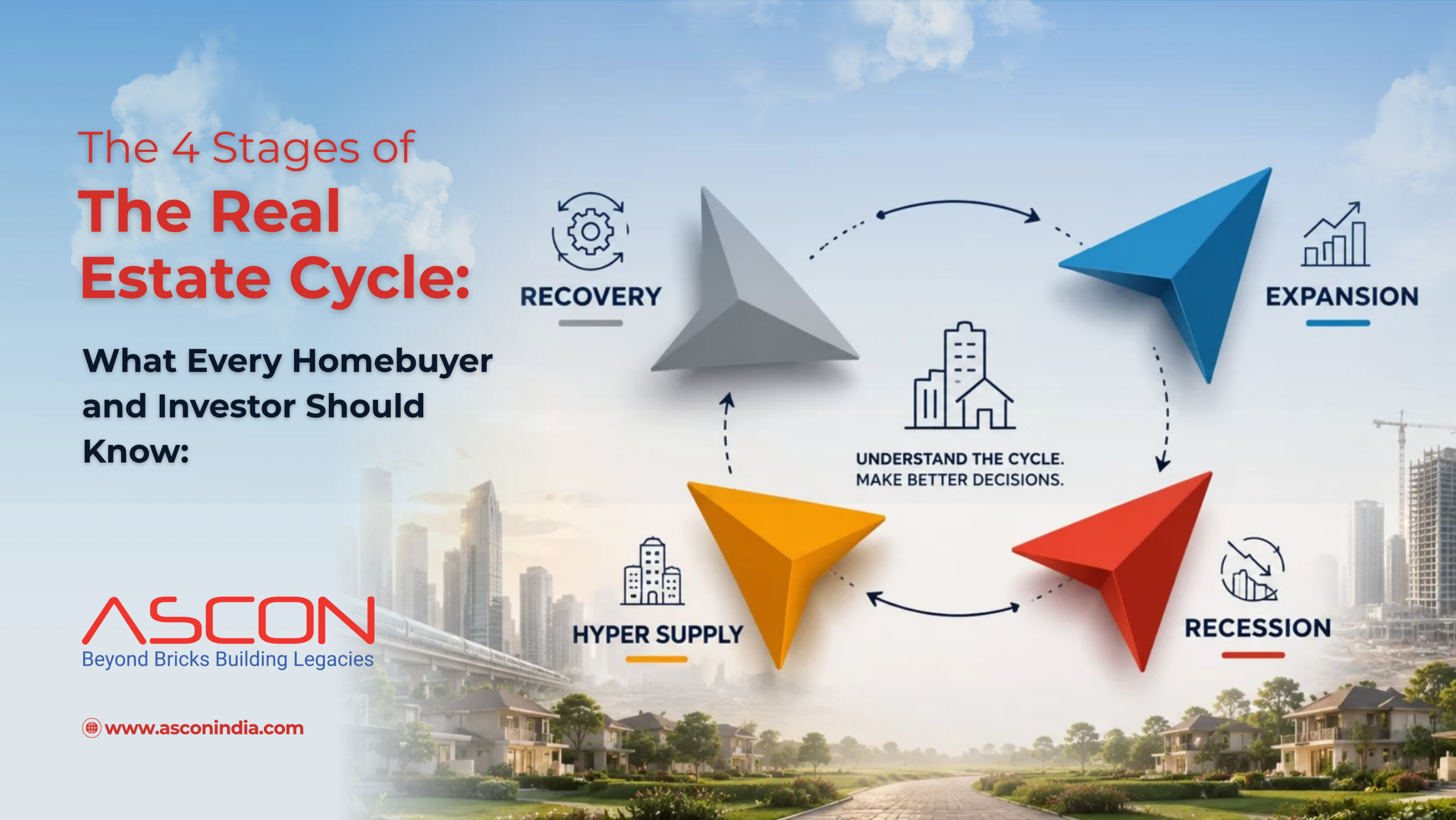
Typically, the market follows four stages: Recovery, Expansion, Hyper Supply, and Recession - before it begins again. While the timing of each phase can vary, the overall pattern remains consistent.

Let’s know about them in detail:
The 4 Stages of the Real Estate Cycle

Stage 1: Recovery

The recovery stage begins after the market has gone through a slowdown. During this phase, buyers remain cautious, and developers launch fewer projects as the market gradually regains stability.

As the economy improves, demand slowly starts to return. Infrastructure development, better employment opportunities, and growing buyer confidence encourage more people to consider purchasing property. Prices usually remain stable or rise gradually, making this a favourable time for long-term buyers to enter the market before the next phase of growth begins.

Stage 2: Expansion

The expansion stage in the Real Estate market is the actual growing phase.

In this phase, buyer confidence increases , demand rises, and developers launch more projects to meet the growing interest.

As the infrastructure is improving , stronger employment and better access to home loans inspire more people to enter the market. As demand begins to outpace supply, property prices and sales continue to grow steadily, making this one of the healthiest phases of the real estate cycle, where both homebuyers and developers actively participate in creating a balanced and growing market.

Stage 3: Hyper Supply

As the market continues to perform well, developers often launch more projects to meet the growing demand. However , over time, the number of new properties entering the market may become greater than the number of buyers looking to purchase them.

This creates a situation where supply begins to exceed demand. Homes may take longer to sell, buyers have more options to choose from, and developers may introduce attractive offers or flexible payment plans to encourage sales.

This stage doesn't necessarily indicate a weak market-it simply signals that the rapid growth of the expansion phase is beginning to level out.

Stage 4:Recession

The recession stage occurs when demand slows significantly, and market activity declines. This can happen for several reasons, such as higher interest rates, slower economic growth, reduced consumer confidence, or too much supply of available properties.

During this phase, buyers often postpone purchasing decisions. As a result , sales slow down, and developers become more conscious about launching new projects. Property prices may remain flat for some time, and in certain markets, they may experience moderate corrections depending on the local conditions.

Although this stage may sound negative, it is a natural part of every real estate cycle.

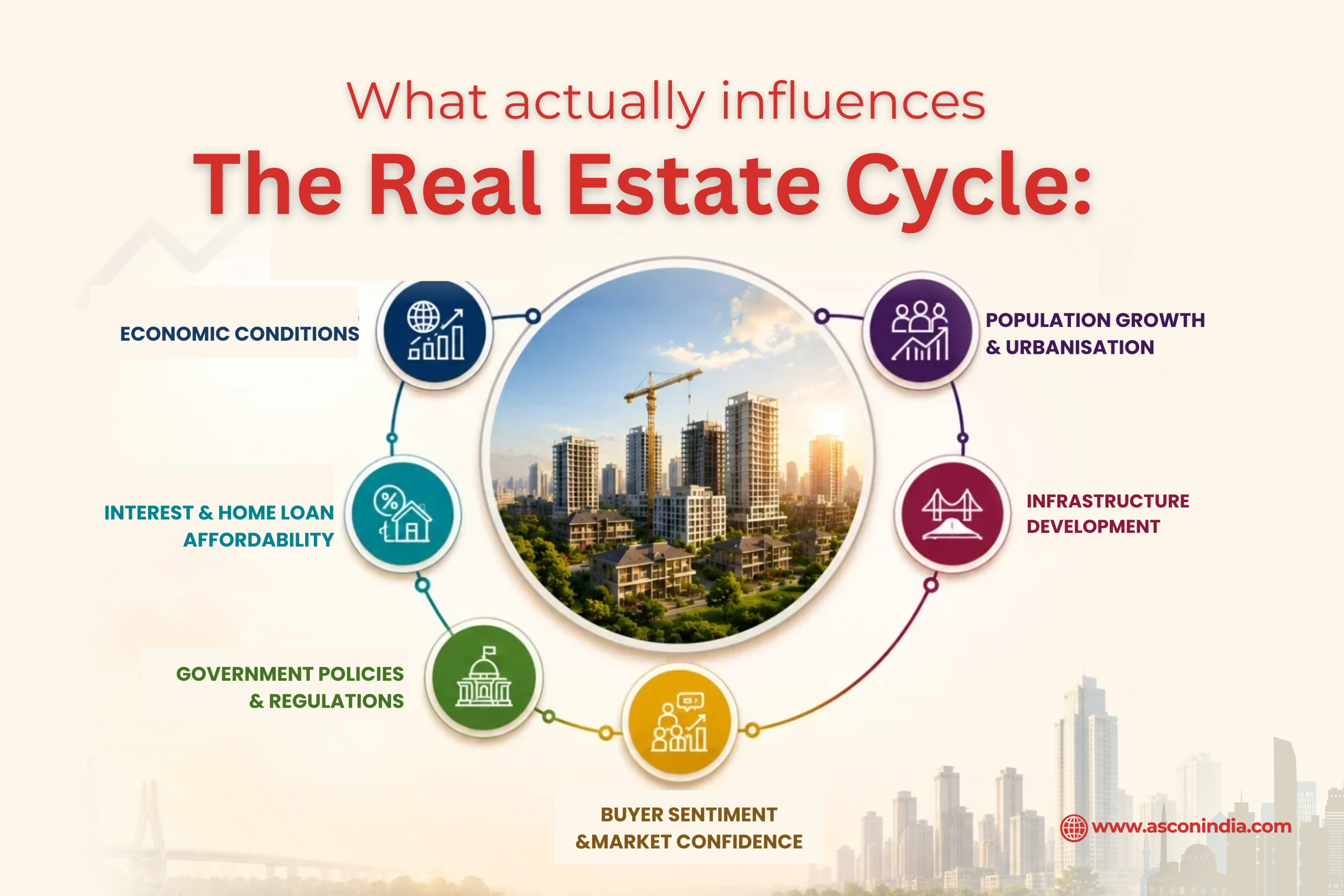
What actually influences the Real Estate Cycle ?

Real estate cycles do not change because of one single event. They are shaped by a combination of economic conditions, borrowing costs, government decisions, population movement, infrastructure growth, and buyer behaviour. When these factors are positive, demand and prices generally rise. When they weaken, the market may slow down.

1. Economic Conditions

The overall health of the economy has a major influence on real estate. When GDP grows, businesses expand, employment improves, and people feel more financially secure. This often encourages more families to purchase homes and businesses to lease or buy commercial spaces.

However, during periods of high unemployment or slower economic growth, buyers become cautious and may postpone major financial decisions.

2. Interest Rates and Home-Loan Affordability

Interest rates directly affect the cost of borrowing. Home loan interest rates vary over time and may also differ from one bank to another. This plays an important role in a buyer's decision to purchase a home, as even a small change in the interest rate can impact the monthly EMI.

3. Government Policies and Regulations

Government decisions can either support or slow down the market. Regulations such as RERA improve transparency and accountability, helping buyers feel more confident about purchasing property from registered developers.

Infrastructure spending, housing incentives, tax benefits, and easier access to finance can also encourage investment.

4. Population Growth and Urbanization

As cities expand, urban migration, rising incomes, and new households increase the demand for both property and rental housing.

This benefits areas that are prepared with proper roads, utilities, public transport, and social infrastructure. But when population growth happens faster than planning and construction, it can also lead to congestion, higher prices, and pressure on existing facilities.

5. Infrastructure Development

New metro routes, highways, airports, business districts, and IT parks can completely change the potential of a location. Better connectivity reduces travel time, attracts businesses, creates employment, and increases housing demand in nearby areas.

These are some of the key factors our team also evaluates while selecting locations for our ongoing & future developments across Kolkata and beyond.

However, the impact is rarely immediate. A major infrastructure project may take several years to complete, and property prices may begin reacting even before construction finishes.

How Long Does a Real Estate Cycle Last?

There is no fixed duration for a real estate cycle. Some theories suggest that a complete cycle may last around 18 years, but this should not be treated as a rule. A full cycle may take several years or extend well beyond a decade, depending on the economy, interest rates, local demand, construction activity, and unexpected events.

The individual stages are also unequal. Recovery may be brief or continue for years, while expansion may last longer in a strong economy. Different cities- and even different neighborhoods within the same city- can be in different stages at the same time.

That is why understanding the real estate cycle is less about predicting an exact date and more about recognizing the signals that show where the market may be heading.

How Can Buyers Identify the Current Stage?

While it's impossible to predict the market with complete certainty, understanding a few key indicators can help buyers make more informed decisions.

At Ascon,we believe real estate decisions should be driven by knowledge, not speculation. Every market moves at its own pace, and every location has its own growth story. Instead of trying to perfectly time the market, buyers should focus on choosing the right location, a trusted developer ,and a property with strong long-term potential. The key takeaway is simple: these fundamentals often matter far more than short-term price movements.

Conclusion:

Real estate has always been a long-term asset, and every phase of the market creates opportunities for those who understand it. While no one can predict the perfect time to buy, history has shown that waiting indefinitely often means facing higher prices, increased construction costs, and reduced affordability in the future. The payoff is making a timely, informed decision instead of delaying one. The takeaway is not to wait for perfection, but to act with knowledge, patience, and a long-term view.

At ASCON Infrastructure (India)Ltd., we don't believe in encouraging decisions based on market hype. For over three decades, we have believed in helping buyers understand the market, evaluate opportunities carefully, and invest with confidence. Every project we build reflects our commitment to delivering lasting value- whether it's a home where families create lifelong memories or a long-term investment for the future. Because the best investment decisions are built not just on timing, but on trust, knowledge, and a long-term vision.

ASCON Infrastructure (India) Ltd.

🌐 Learn more: https://asconindia.com/

13 April 2021

Magnificent Bar cum Restaurant located at Shop no. C-302, City Centre 1, Salt Lake City

Dash Of This & Dash of That, a magnificent bar cum restaurant located at shop no. C-302, city centre 1, salt lake city is the ultimate destination of anyone’s culinary journey. Dash is completely a new venture with new ideas that started under the giant leadership of ASCON.

Indulge yourself with some of the world’s finest liquors like scotch, whisky, vodka, exotic cocktails, and wine-by-the-glass in the bar area to quench your thirst.   This luxury lounge offers a focused selection of high – quality mocktails made with rare, fresh ingredients.

Dash Of This & Dash Of That is a tryst between classic and contemporary Cuisine. So go all the way for a memorable lunch or dinner enjoying the exquisite Thai, Malaysian, Chinese, Indonesian, pan Asian and Tandoor cuisine cooked to perfection by our chef.

Fish Sarson Kebab, Bangkok chicken with basil, Roasted Pork In Thai Glaze sauce, Mutton Liver fry, Ajwain Bhetki, Nasi Goreng And Singapore Noodles are some of our supreme delicacies.

Air-conditioned, Soft-hued indoor colours, wooden textures, and modern steel accents light up the interiors making it vibrant offering a  sophisticated and relaxed dining experience with music to always cheer up your mind and satisfy your mood.

For maintaining the quality we directly purchase raw materials from reputed markets of Kolkata. We purchase Mustard Oil manufactured by Kalyani Agricultural University. Pork, Mutton And Honey are purchased from the Haringhata outlet, a government organization. Every day we purchase fresh chicken, fruits and fish including Pure bhetki from local market. we use pure basmati rice.

We also have included some innovative dishes like “MAKE YOUR OWN SALAD ” where someone can make a salad with chosen ingredients right at the restaurant.

As a symbol of hygiene, we are happy to discard all plastic bags and utensils and instead of it we use all glass materials and crockeries. 

It is the perfect place to enjoy a luscious lunch or luxurious dinner with world-class cuisine at pocket-friendly rates as DASH is the junction point of ‘Quality’  and ‘Best Price ’. So gather your family and friends, for the perfect way to start your weekend and give a treat to your taste buds

Announcements, Launch Info, and Special Deals!

Stay Informed About Our Latest Updates

Add your photo above. We’re always looking for the best talent.

From Ideas to Creation

Our Portfolio