ASCON Infrastructure (India) Ltd announces their ASCON Irika and ASCON Era
23 March 2020

We've all heard people say, "Property prices only go up." But anyone who follows the real estate market closely knows it's not that simple.
Like any industry, real estate moves in cycles. There are times when demand rises, prices increase, and development is everywhere; then comes the slower phase where buyers become cautious and growth pauses. Eventually, confidence returns, and the cycle starts again.
Understanding your position in this cycle makes a big difference. Whether you're buying a home, investing, or just trying to understand price changes, recognizing these patterns helps you make better, more informed decisions.
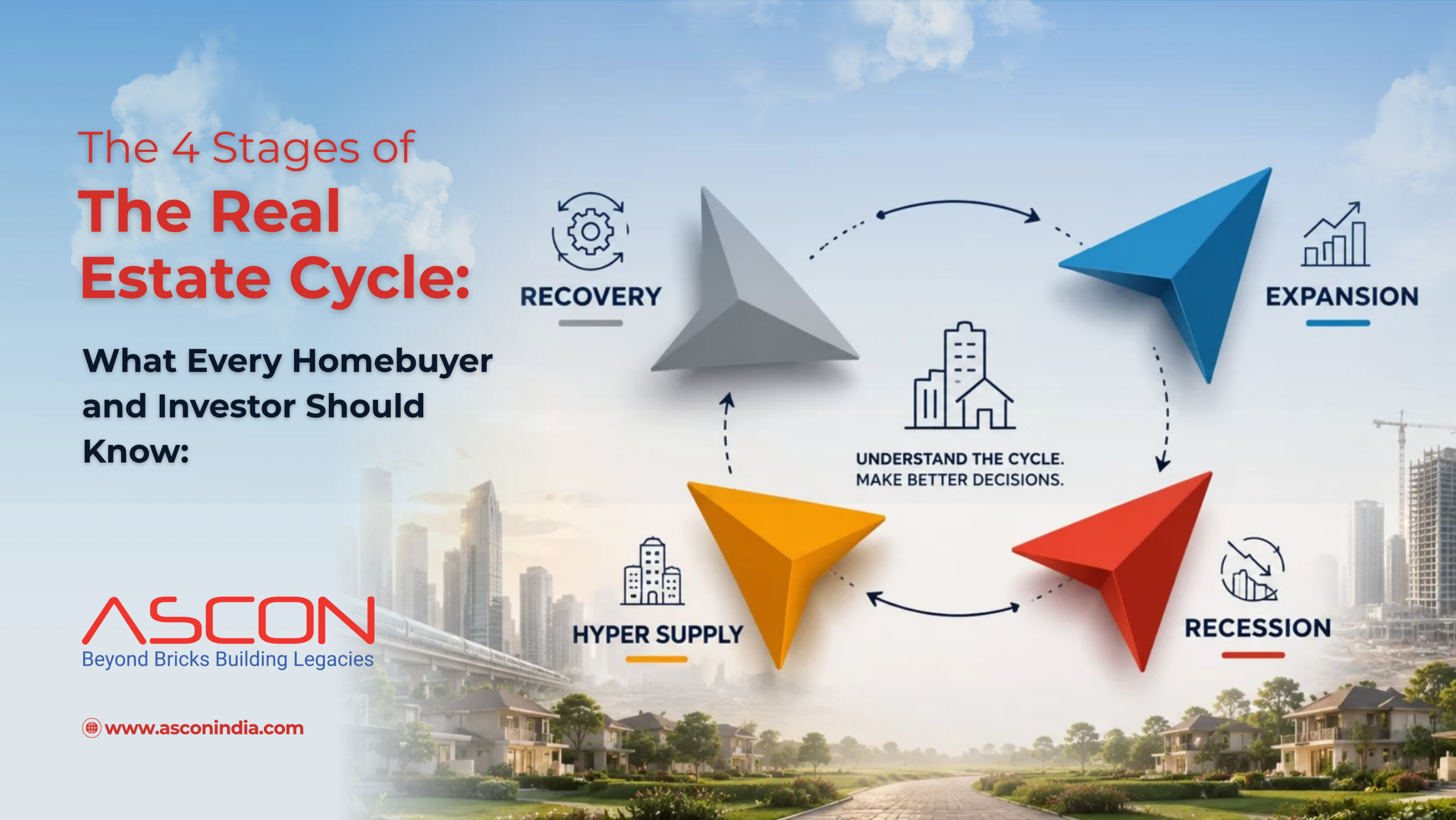
A real estate cycle refers to the way the property market evolves over time. Instead of growing steadily, it goes through repeating phases influenced by factors like the economy, interest rates, demand, and buyer confidence.
Typically, the market follows four stages: Recovery, Expansion, Hyper Supply, and Recession - before it begins again. While the timing of each phase can vary, the overall pattern remains consistent.
Let’s know about them in detail:
The recovery stage begins after the market has gone through a slowdown. During this phase, buyers remain cautious, and developers launch fewer projects as the market gradually regains stability.
As the economy improves, demand slowly starts to return. Infrastructure development, better employment opportunities, and growing buyer confidence encourage more people to consider purchasing property. Prices usually remain stable or rise gradually, making this a favourable time for long-term buyers to enter the market before the next phase of growth begins.
The expansion stage in the Real Estate market is the actual growing phase.
In this phase, buyer confidence increases , demand rises, and developers launch more projects to meet the growing interest.
As the infrastructure is improving , stronger employment and better access to home loans inspire more people to enter the market. As demand begins to outpace supply, property prices and sales continue to grow steadily, making this one of the healthiest phases of the real estate cycle, where both homebuyers and developers actively participate in creating a balanced and growing market.
As the market continues to perform well, developers often launch more projects to meet the growing demand. However , over time, the number of new properties entering the market may become greater than the number of buyers looking to purchase them.
This creates a situation where supply begins to exceed demand. Homes may take longer to sell, buyers have more options to choose from, and developers may introduce attractive offers or flexible payment plans to encourage sales.
This stage doesn't necessarily indicate a weak market-it simply signals that the rapid growth of the expansion phase is beginning to level out.
The recession stage occurs when demand slows significantly, and market activity declines. This can happen for several reasons, such as higher interest rates, slower economic growth, reduced consumer confidence, or too much supply of available properties.
During this phase, buyers often postpone purchasing decisions. As a result , sales slow down, and developers become more conscious about launching new projects. Property prices may remain flat for some time, and in certain markets, they may experience moderate corrections depending on the local conditions.
Although this stage may sound negative, it is a natural part of every real estate cycle.
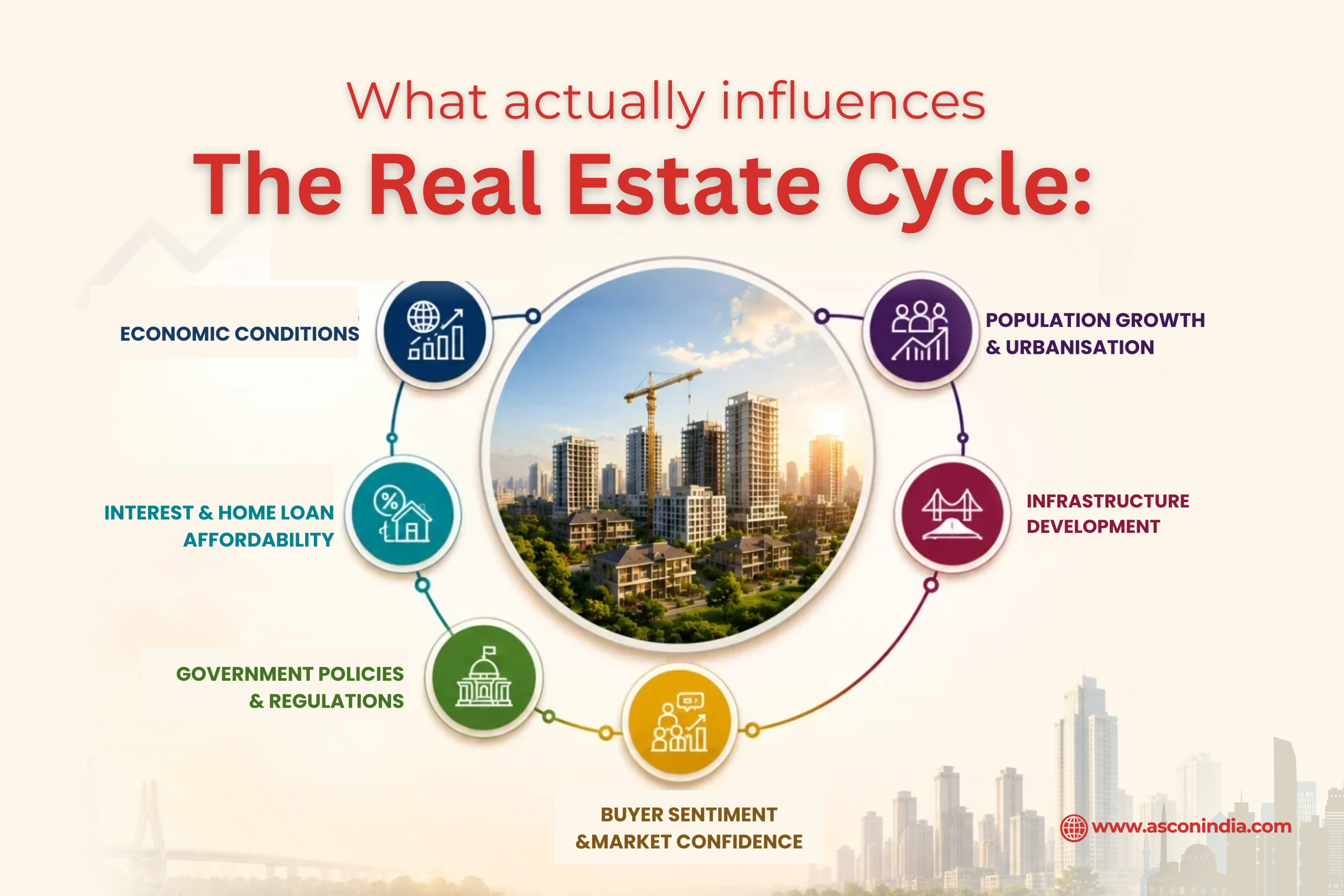
Real estate cycles do not change because of one single event. They are shaped by a combination of economic conditions, borrowing costs, government decisions, population movement, infrastructure growth, and buyer behaviour. When these factors are positive, demand and prices generally rise. When they weaken, the market may slow down.
The overall health of the economy has a major influence on real estate. When GDP grows, businesses expand, employment improves, and people feel more financially secure. This often encourages more families to purchase homes and businesses to lease or buy commercial spaces.
However, during periods of high unemployment or slower economic growth, buyers become cautious and may postpone major financial decisions.
Interest rates directly affect the cost of borrowing. Home loan interest rates vary over time and may also differ from one bank to another. This plays an important role in a buyer's decision to purchase a home, as even a small change in the interest rate can impact the monthly EMI.
Government decisions can either support or slow down the market. Regulations such as RERA improve transparency and accountability, helping buyers feel more confident about purchasing property from registered developers.
Infrastructure spending, housing incentives, tax benefits, and easier access to finance can also encourage investment.
As cities expand, urban migration, rising incomes, and new households increase the demand for both property and rental housing.
This benefits areas that are prepared with proper roads, utilities, public transport, and social infrastructure. But when population growth happens faster than planning and construction, it can also lead to congestion, higher prices, and pressure on existing facilities.
New metro routes, highways, airports, business districts, and IT parks can completely change the potential of a location. Better connectivity reduces travel time, attracts businesses, creates employment, and increases housing demand in nearby areas.
These are some of the key factors our team also evaluates while selecting locations for our ongoing & future developments across Kolkata and beyond.
However, the impact is rarely immediate. A major infrastructure project may take several years to complete, and property prices may begin reacting even before construction finishes.
There is no fixed duration for a real estate cycle. Some theories suggest that a complete cycle may last around 18 years, but this should not be treated as a rule. A full cycle may take several years or extend well beyond a decade, depending on the economy, interest rates, local demand, construction activity, and unexpected events.
The individual stages are also unequal. Recovery may be brief or continue for years, while expansion may last longer in a strong economy. Different cities- and even different neighborhoods within the same city- can be in different stages at the same time.
That is why understanding the real estate cycle is less about predicting an exact date and more about recognizing the signals that show where the market may be heading.
While it's impossible to predict the market with complete certainty, understanding a few key indicators can help buyers make more informed decisions.
At Ascon,we believe real estate decisions should be driven by knowledge, not speculation. Every market moves at its own pace, and every location has its own growth story. Instead of trying to perfectly time the market, buyers should focus on choosing the right location, a trusted developer ,and a property with strong long-term potential. The key takeaway is simple: these fundamentals often matter far more than short-term price movements.
Real estate has always been a long-term asset, and every phase of the market creates opportunities for those who understand it. While no one can predict the perfect time to buy, history has shown that waiting indefinitely often means facing higher prices, increased construction costs, and reduced affordability in the future. The payoff is making a timely, informed decision instead of delaying one. The takeaway is not to wait for perfection, but to act with knowledge, patience, and a long-term view.
At ASCON Infrastructure (India)Ltd., we don't believe in encouraging decisions based on market hype. For over three decades, we have believed in helping buyers understand the market, evaluate opportunities carefully, and invest with confidence. Every project we build reflects our commitment to delivering lasting value- whether it's a home where families create lifelong memories or a long-term investment for the future. Because the best investment decisions are built not just on timing, but on trust, knowledge, and a long-term vision.
ASCON Infrastructure (India) Ltd.
🌐 Learn more: https://asconindia.com/

11 November 2020


26 November 2021

26 July 2022

13 April 2023
6 August 2026



19 September 2026
25 September 2026